
01
Five hours aloft
Up to five hours with 10 kg on board — enough for a full pipeline corridor or a wide survey block in one sortie.
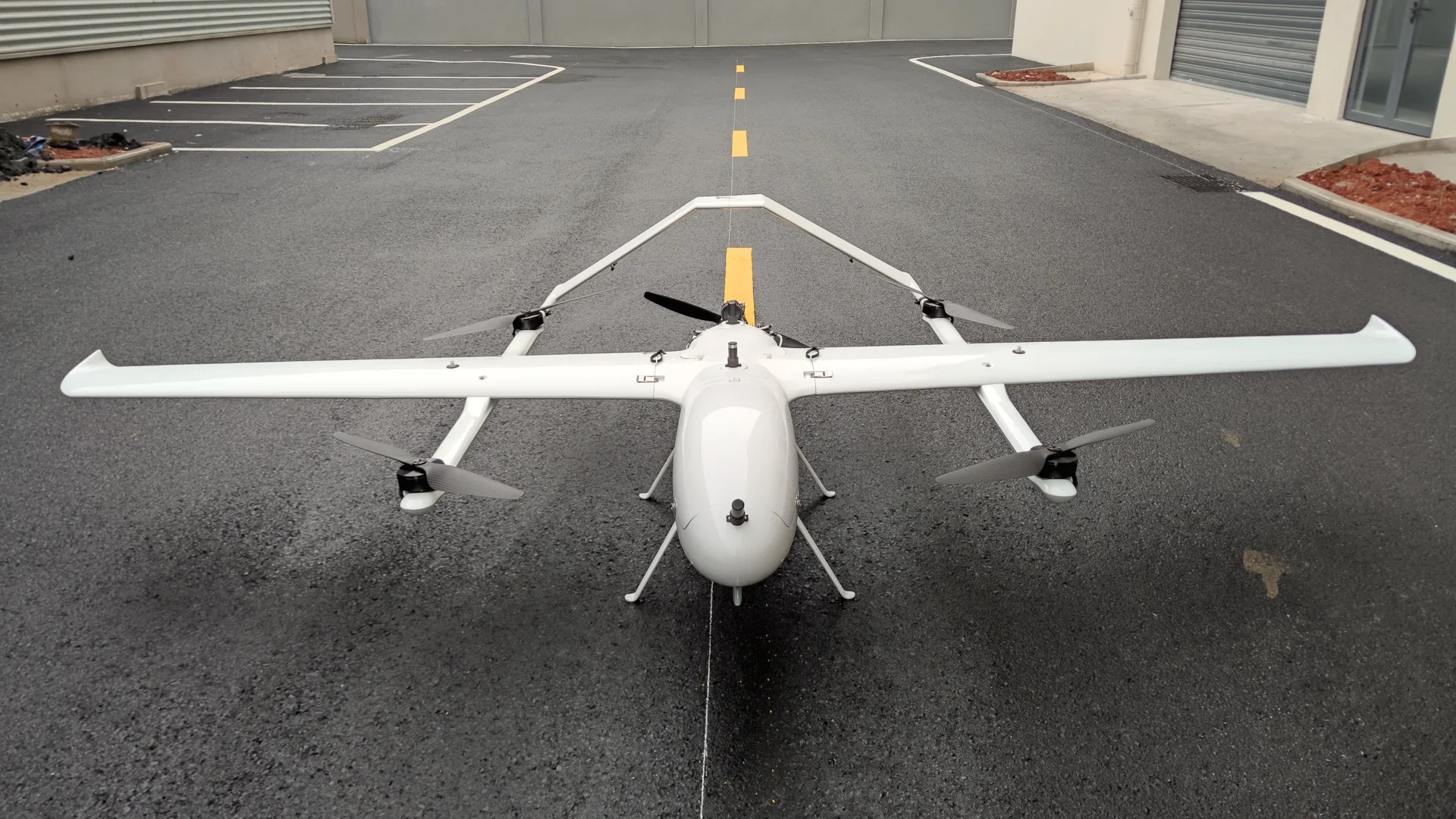
PD-VF50P · Gasoline VTOL fixed-wing
Vertical take-off, wing-borne cruise and up to five hours aloft — a 15 kg payload platform for survey, inspection and response work.
Overview
The VF50P is a gasoline-electric VTOL fixed-wing UAV for missions where a multirotor runs out of time and a runway is not available. Four lift rotors handle vertical take-off and landing; the wing takes over in cruise.
At 55 kg maximum take-off weight, it carries up to 15 kg of mission equipment on a 3.8 m wing. Twelve litres of fuel give three hours at full payload and five hours at 10 kg.
The aircraft is built around long, linear work: corridor mapping, power-line and pipeline patrol, emergency observation and border or site patrol. A 30 km ground-station link keeps the operator clear of the work area, while a 1 km handheld link covers launch and recovery.
VTOL architecture
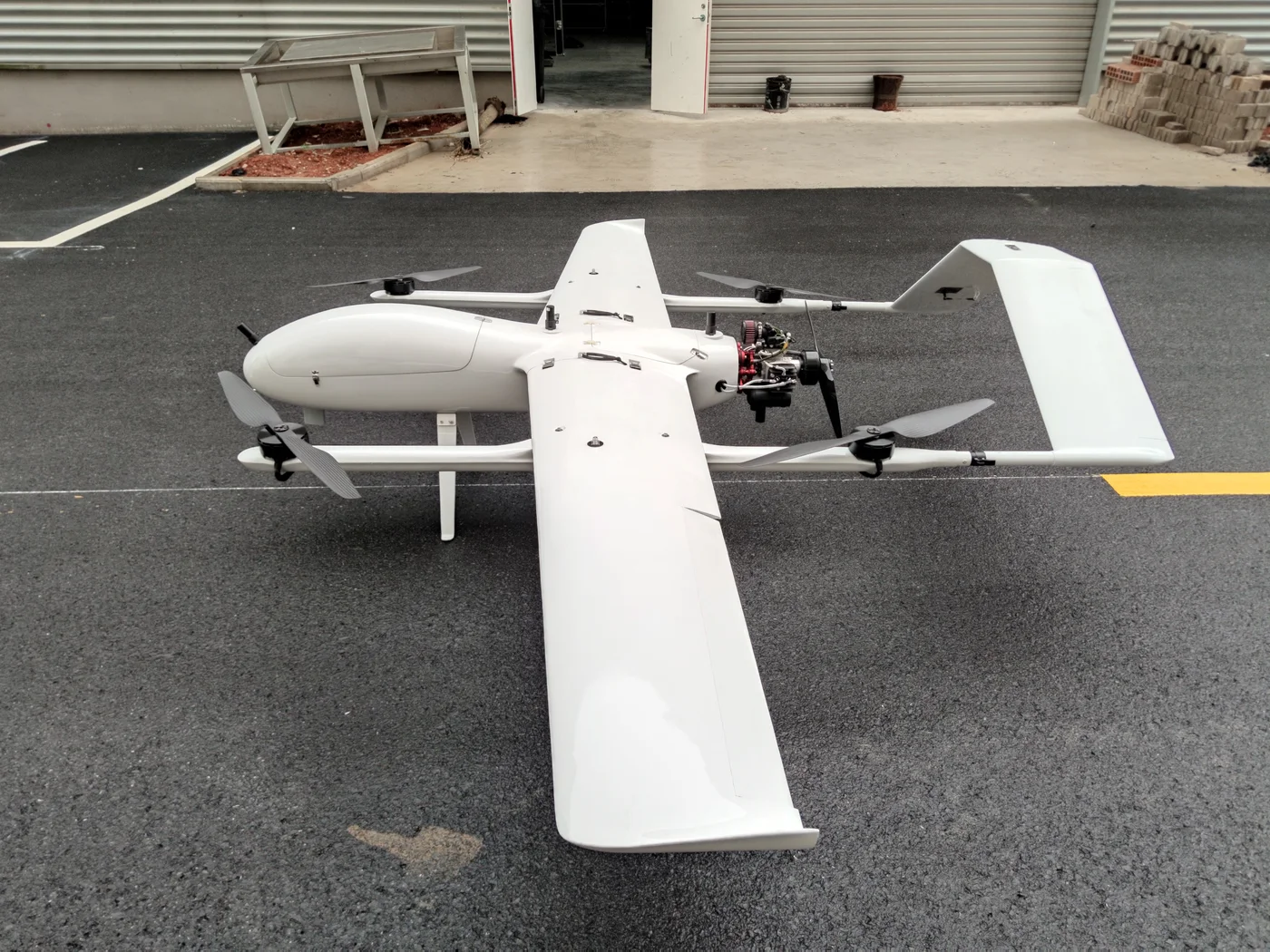
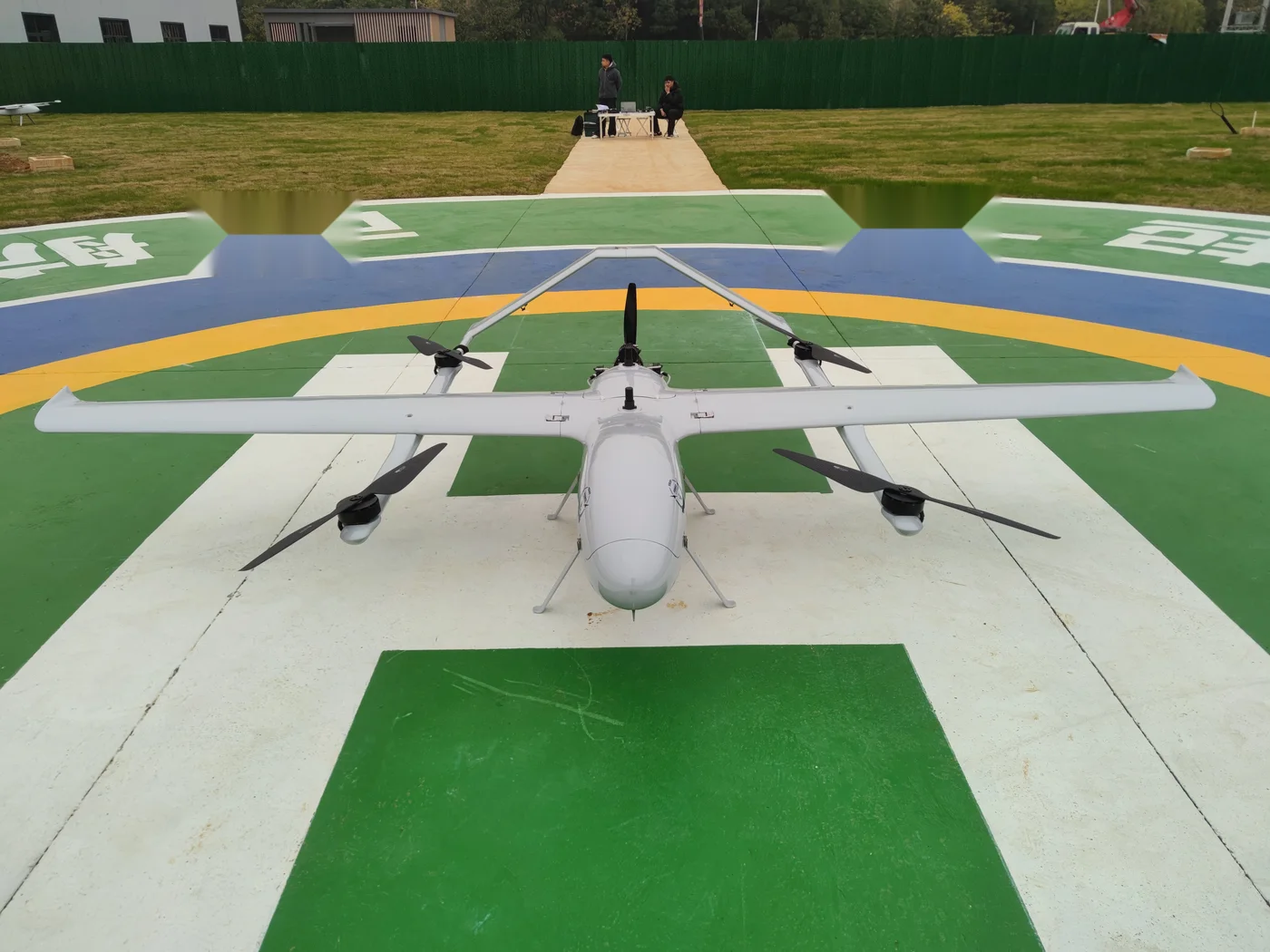
The compound-wing layout combines four vertical-lift rotor units with a conventional fixed wing, so the aircraft launches from a small site and then flies like a wing-borne aircraft.
Four lift rotorsVertical take-off and landing
No runway, catapult or launch crew. The aircraft climbs and lands vertically from a compact prepared area.
3.8 m compound wingWing-borne cruise
In cruise the fixed wing carries the aircraft, which is where the long endurance and 150 km/h top speed come from.
Gasoline power12 L fuel
A gasoline engine provides hours rather than minutes of flight; refuelling between sorties is quicker than recharging battery packs.
Under-fuselage payload bayUp to 15 kg
Mission equipment is carried under the fuselage. Payload and endurance are traded directly: 15 kg gives 3 hours, 10 kg gives 5 hours.
Endurance
Published VF50P endurance figures, measured at sea level and 25 °C. Fuel capacity, not battery state, sets the length of the sortie.
Payload versus flight time
Plan for reserve fuel and return-to-base time. Actual endurance varies with altitude, temperature, wind and the installed payload.
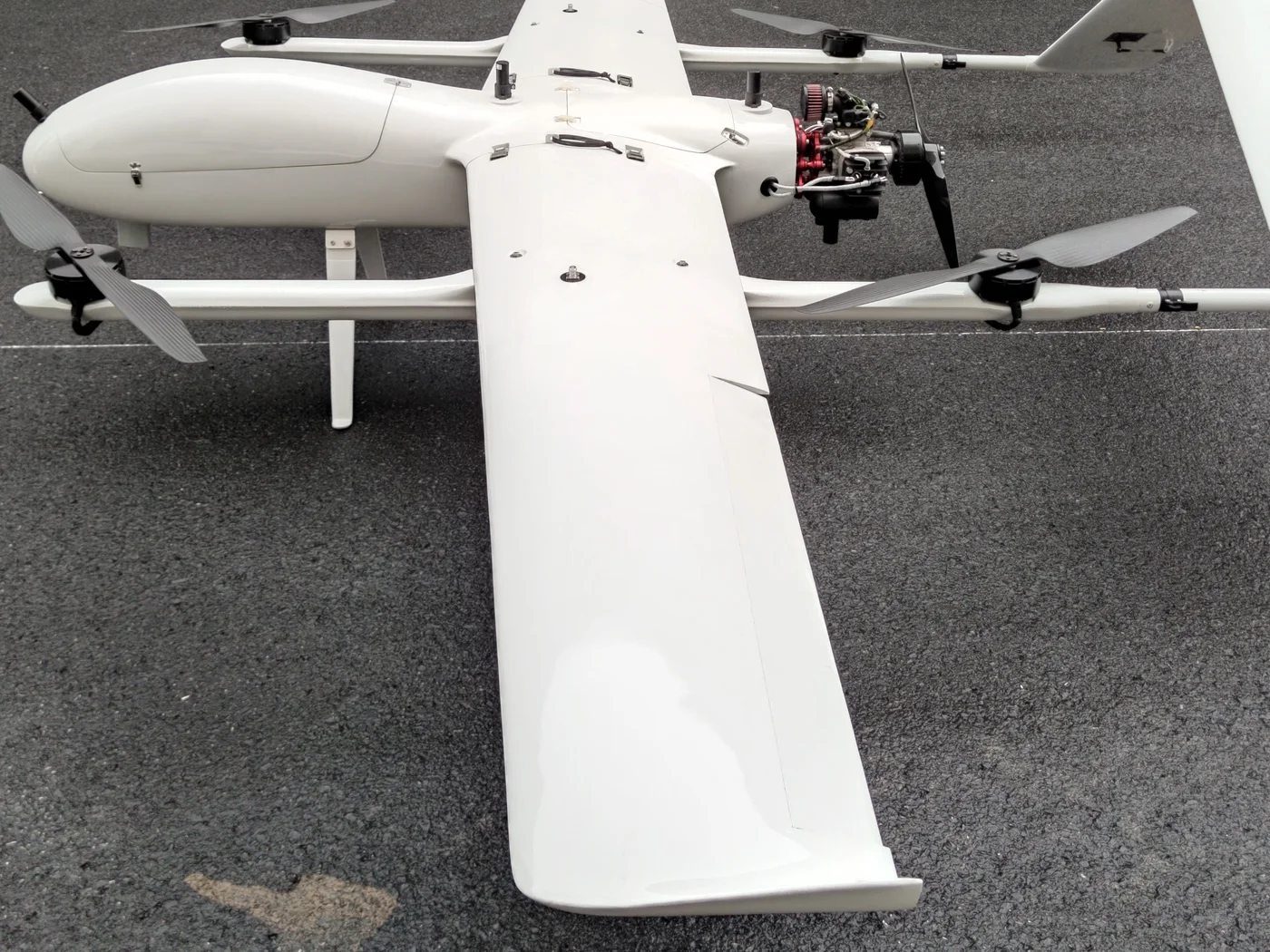
Gasoline power removes the battery-recharge cycle from the mission day. The aircraft refuels on site and returns to work.
Flight envelope
The published envelope covers the conditions crews meet on survey, inspection and response tasks.
Up to five hours with 10 kg on board — enough for a full pipeline corridor or a wide survey block in one sortie.
Ground-station control reaches 30 km in open, interference-free conditions; the handheld controller covers 1 km for launch and recovery.
Rated for 12 m/s wind, so exposed coastal, ridge and open-plain sites remain workable within the published limit.
A 3,000 m ceiling supports highland survey and inspection; payload and fuel planning is required at altitude.
Applications
Six recurring missions where fixed-wing endurance beats a multirotor's hover time.
Corridor and block mapping, orthophoto and terrain data collection over areas too large for a multirotor sortie.
Tower, line and substation inspection along a corridor without taking the circuit out of service.
Route patrol, valve-station inspection and leak-response support along long pipeline networks.
Airborne situation awareness and small-payload delivery during the first hours of a fire, flood or rescue task.
Persistent aerial observation for patrol, evidence collection and search work over wide areas.
Upper-air sampling and environmental monitoring over remote or hazardous terrain.
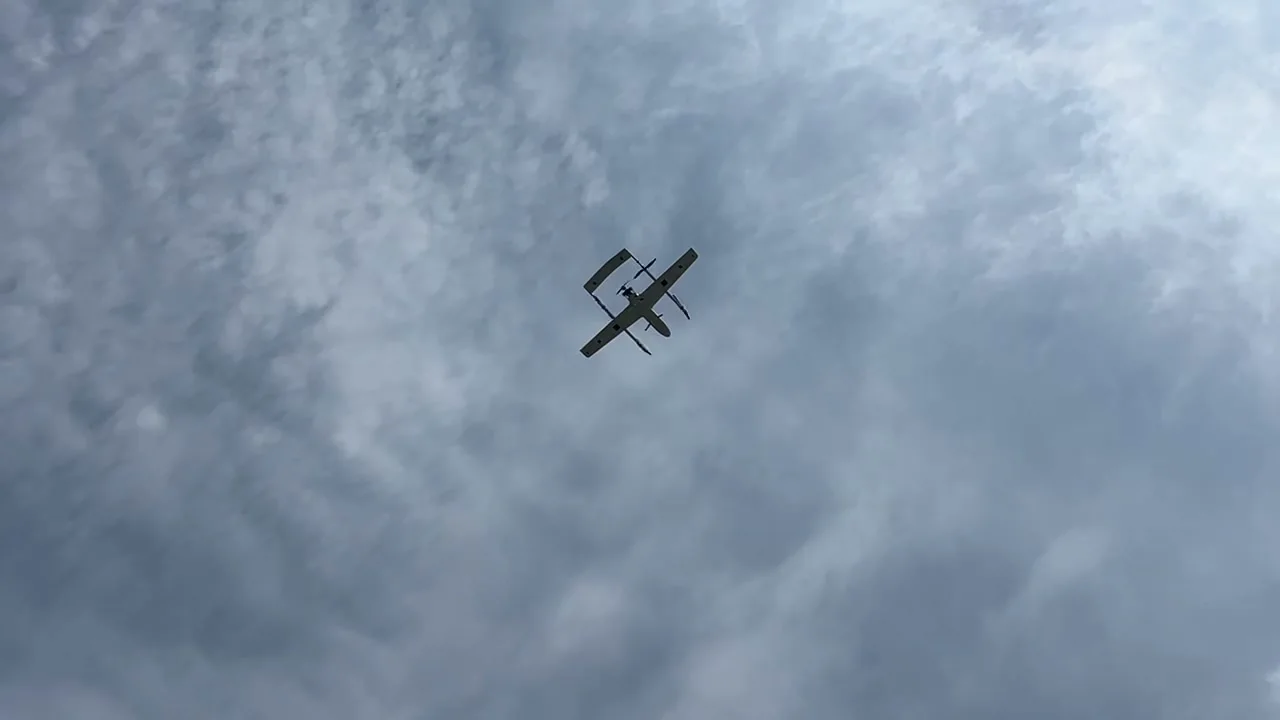
Flight demonstration
Vertical take-off, transition to wing-borne flight and cruise, filmed at a flight-test facility.
Flight-test footage · VTOL take-off and fixed-wing cruise
Specifications
| Aircraft type | Gasoline-electric VTOL fixed-wing UAV |
|---|---|
| Layout | Compound wing with four lift rotors |
| Maximum take-off weight | 55 kg |
| Maximum payload | 15 kg |
| Wingspan | 3.8 m |
| Length | 2.5 m |
| Fuel capacity | 12 L gasoline |
| Endurance at 15 kg | 3 h |
| Endurance at 10 kg | 5 h |
| Maximum level speed | 150 km/h |
| Cruise speed | 100 km/h |
| Service ceiling | 3,000 m |
| Wind resistance | 12 m/s |
| Operating temperature | -10 °C to 45 °C |
| Ground-station range | 30 km, unobstructed and interference free |
| Handheld controller range | 1 km |
| Payload interface | Under-fuselage payload bay |
| Take-off and landing | Vertical, no runway required |
FAQ
Up to 15 kg under the fuselage. Endurance is published as 3 hours at the full 15 kg and 5 hours at 10 kg. The specific survey, inspection or cargo fit is confirmed with engineering during configuration.
No. The VF50P uses four lift rotors for vertical take-off and landing, then transitions to wing-borne cruise. It can operate from a compact prepared site rather than a runway.
A gasoline engine with a 12 L tank drives the fixed-wing cruise. The aircraft refuels on site between sorties; no battery pack swap or recharge cycle is required for the cruise phase.
The ground station reaches 30 km in unobstructed, interference-free conditions. A handheld controller covers 1 km for take-off, landing and local manual control.
The published envelope is 12 m/s wind, -10 °C to 45 °C and a 3,000 m service ceiling. Plan payload and fuel for high-altitude or high-temperature sites.
With 10 kg on board the published endurance is 5 hours; at 15 kg it is 3 hours. Reserve fuel for transit, weather and return-to-base must be planned separately.
Partdro supplies the aircraft, ground station and handheld controller with configuration and after-sales planning. Shipping, spares and training are quoted for the destination country.
Approval depends on the jurisdiction. Partdro supports operators with documentation and configuration choices, but the operator remains responsible for permits and flight rules.
Send the mission profile, payload idea and destination through the quote form. Our team replies with pricing, lead time and shipping options.
Global pricing, tailored to you
VF50P pricing depends on payload fit, ground-station configuration, destination and support scope. Tell us what the aircraft has to do and our team will return a tailored offer.
* Check, confirm and strictly comply with local laws and regulations before flying.
** Flight imagery on this page was captured at a test facility. Product appearance is subject to the shipped configuration.
*** Endurance, speed and range figures are published manufacturer values; confirm the final configuration with Partdro before planning a mission.
1. Endurance figures are published for sea-level altitude and 25 °C ambient temperature: 3 hours at 15 kg payload and 5 hours at 10 kg payload. Fuel load, altitude, temperature, wind and payload change the result.
2. The 30 km ground-station range and 1 km handheld-controller range were measured in open, interference-free conditions. Observe return-to-base prompts and local radio regulations in operation.
3. The 3,000 m service ceiling and 12 m/s wind limit are published maxima. Reduce payload or fuel and plan alternative tasking when operating near those limits.
4. Payload integration, sensor selection and cargo fittings are confirmed per order. The airframe shown may carry different mission equipment from the delivered aircraft.